Press Brake Bending Tonnage Calculation: Formula & Example
Release time: 2026-06-01
Press brake tonnage calculation is one of the most important steps before bending sheet metal. The required force depends on the material tensile strength, sheet thickness, bending length, V-die opening, and forming method. An incorrect estimate can cause incomplete bending, excessive deflection, premature tooling wear, or machine overload.
This guide explains how to estimate the bending force required for a 90° air bend, calculate a practical machine capacity, and check the factors that can change the final tonnage requirement.
What Determines Press Brake Tonnage?
The required bending force is mainly controlled by five variables:
- Material tensile strength: Higher-strength materials require more force than mild steel.
- Sheet thickness: Bending force increases approximately with the square of the material thickness.
- Bending length: A longer bend requires proportionally more total force.
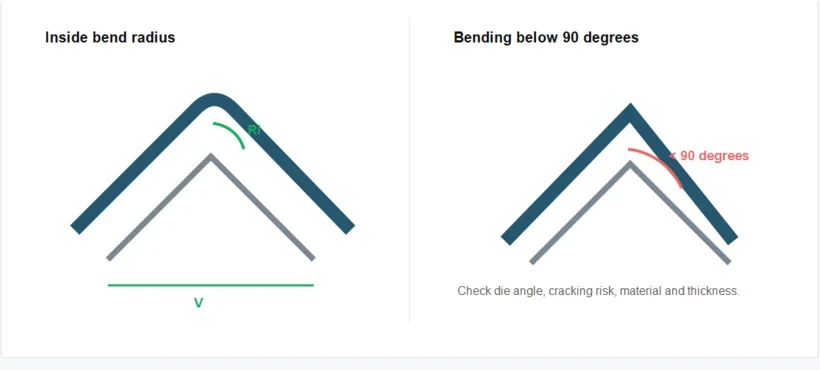
- V-die opening: A smaller opening increases the required force, while a wider opening reduces it.
- Forming method: Air bending, bottom bending, and coining have substantially different force requirements.
The formula and example below are intended for preliminary calculation of a 90° air bend. Final machine selection should always be confirmed against the press brake manufacturer’s tonnage chart and the load capacity of the selected punch and die.
Press Brake Bending Force Formula
When tensile strength is expressed in kgf/mm², the following metric formula can be used to estimate the required air-bending force:
P = (1.42 × σb × S² × L) ÷ (1,000 × V)
Where:
- P = Required bending force in metric tonnes
- σb = Material tensile strength in kgf/mm²
- S = Sheet thickness in millimetres
- L = Bending length in millimetres
- V = V-die opening in millimetres
If tensile strength is provided in N/mm², do not insert the value into the kgf/mm² formula without conversion. A practical conversion is:
1 kgf/mm² ≈ 9.81 N/mm²
For example, a tensile strength of 45 kgf/mm² is approximately equal to 441 N/mm². Mixing the two unit systems can produce a result that is nearly ten times too high or too low.
Worked Example: 3 mm Carbon Steel
Consider a Q235-type carbon steel workpiece with the following preliminary bending conditions:
- Material tensile strength: 45 kgf/mm²
- Sheet thickness: 3 mm
- Bending length: 2,000 mm
- V-die opening: 24 mm
- Forming method: 90° air bending
Insert these values into the formula:
P = (1.42 × 45 × 3² × 2,000) ÷ (1,000 × 24)
P = 47.925 metric tonnes
The calculated bending force is therefore approximately 48 tonnes.
Adding a Practical Capacity Reserve
For preliminary machine sizing, a practical reserve may be added for material variation, tooling condition, sheet-thickness tolerance, and production stability. Using a 25% reserve in this example:
48 tonnes × 1.25 = 60 tonnes
A press brake with at least 60 tonnes of nominal capacity may therefore be considered for this application, provided that the machine’s working length, tooling capacity, load distribution, and manufacturer’s bending chart also meet the requirement.
The reserve is a machine-selection allowance, not permission to exceed the rated capacity of the press brake or tooling.
How the V-Die Opening Affects Tonnage
For conventional air bending of mild steel, a V-die opening of approximately eight times the sheet thickness is commonly used as an initial reference:
V ≈ 8 × S
For a 3 mm sheet, this gives a preliminary opening of 24 mm. However, the final V-opening must also satisfy the required inside radius, minimum flange length, material ductility, surface-quality requirement, and available tooling.
- A smaller V-opening produces a tighter bend radius but requires more tonnage.
- A wider V-opening reduces the required force but increases the natural inside radius.
- Very narrow openings can increase marking, cracking risk, and tooling load.
- The selected opening must remain compatible with the required flange dimensions.
Material Strength and Forming Method
The example above uses carbon steel with an assumed tensile strength of 45 kgf/mm². Stainless steel, high-strength steel, and aluminium alloys can require different forces even when the sheet thickness and bending length are identical.
For reliable results, use the tensile-strength value from the actual material certificate or the material supplier. A fixed material multiplier should only be used as a preliminary estimate.
The forming method must also be confirmed. Air bending requires less force because the sheet does not fully contact the sides of the die. Bottom bending and coining require considerably more force and should not be calculated using the air-bending result alone.
Safety Checks Before Selecting a Press Brake
A calculated tonnage value is only one part of press brake selection. Before production, confirm all of the following:
- The machine’s nominal tonnage exceeds the calculated production requirement.
- The required bend length fits within the usable working length of the machine.
- The punch, die, adapters, and clamping system can withstand the load.
- The tonnage-per-metre limit of the tooling is not exceeded.
- The V-opening is suitable for the sheet thickness, inside radius, and flange length.
- The load is properly distributed and does not create unsafe off-centre loading.
- The machine stroke, daylight, throat depth, and open height suit the workpiece.
- Crowning compensation is considered for long bending lengths.
- The workpiece and tooling cannot collide during the bending sequence.
For heavy plates, long parts, or high-strength materials, the frame structure, table deflection, tooling system, material handling, and foundation requirements should be reviewed together with the calculated tonnage.
Selecting the Right ZYMT Press Brake
Anhui ZYMT CNC Machine Tool Co., Ltd., a manufacturing subsidiary of PREF Group, supplies press brake configurations for conventional bending, CNC production, and heavy-duty fabrication.
Machine selection should be based on the actual material, maximum thickness, bending length, drawing requirements, production volume, tooling, and required CNC functions—not tonnage alone.
For repeat production and multi-step parts, review the available CNC press brake machines. Thick plates and long structural components may require a purpose-built large-tonnage press brake.
Frequently Asked Questions
Does a smaller V-die opening require more tonnage?
Yes. When the sheet thickness, material, and bending length remain unchanged, reducing the V-die opening increases the required bending force. The tooling load and minimum flange requirement must also be checked.
Is an eight-times-thickness V-opening always correct?
No. V ≈ 8 × sheet thickness is a useful starting point for many mild-steel air-bending applications. The required bend radius, flange length, material strength, surface finish, and tooling availability may require a different opening.
Can the calculated force equal the machine’s maximum tonnage?
Continuous production at the exact maximum rating is generally not the preferred selection approach. Allowance should be considered for process variation, but the final reserve must be evaluated together with the machine manufacturer and the tooling load limits.
Final Recommendation
Press brake tonnage calculation provides an essential starting point, but it does not replace the machine and tooling load charts. Confirm the material tensile strength, sheet thickness, bending length, V-opening, bend radius, forming method, and tooling capacity before choosing a press brake.
For an application-specific recommendation, send PREF Group your material grade, thickness, maximum bending length, part drawings, required angles, and production volume through the contact page. The ZYMT technical team can review the required tonnage, working length, tooling, CNC control, and optional configuration.